
In a landmark effort to bolster food systems resilience, researchers under the SWR Ethiopia RAISE-FS project, in collaboration with Wageningen Social & Economic Research, have successfully applied the ABCD[E] framework in Ethiopia’s potato sector. This marks the first real-world implementation of the ABCD[E] framework, which stands for Agency, Buffering, Connectivity, Diversity, and Enablers. The study, conducted in Welmera woreda in the Oromia Region, offers valuable insights into strengthening local food systems and highlights both the potential and challenges of this innovative tool.
What is the ABCD[E] framework?
The ABCD[E] framework is designed to assess and enhance food systems resilience by integrating core capacities with a structured eight-step process.
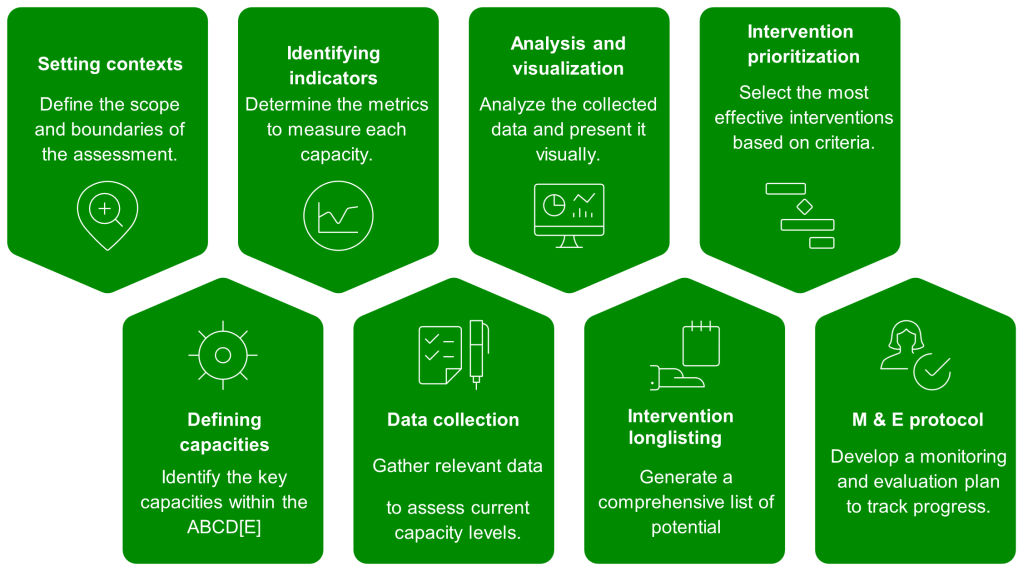
A new approach to assess food systems resilience in Ethiopia
As part of its objective, the SWR Ethiopia RAISE-FS project targets transforming the Ethiopia’s food systems by testing and validating different approaches that address vulnerabilities and improve production and productivity. In this regard, the ABCD[E] framework, was tested in collaboration with farmers, community leaders, and other stakeholders targeting the evaluation of the key assumptions about the framework’s about the framework’s ease of use, applicability and effectiveness. By engaging directly with local stakeholders in the potato sector—a vital component of Ethiopia’s food system—the study explored how resilience capacities manifest in practice and what scalable lessons can be learnt.
Using a participatory action research (PAR) approach, researchers conducted focus group discussions and interviews to understand local resilience strategies. This hands-on engagement provided a wealth of data about how communities navigate risks and adapt to challenges.
Key findings: Resilience in action
The study revealed that stakeholders found the ABCD[E] framework both useful and understandable, underscoring its potential as a practical tool. However, several challenges emerged during its application. Conceptually, the framework requires further refinement to address the complexity of resilience dynamics over time and space. Practically, it demands significant data and familiarity with food systems resilience concepts, which may limit its accessibility for some users.
Despite these challenges, the study uncovered the following critical aspects of resilience in action:
Agency: Farmers demonstrated their ability to mitigate risks through strategies like crop rotation and composting. These actions reflect their capacity to make informed decisions under stress.
Buffering: Communities employed diverse coping mechanisms, such as saving livestock and forming social savings associations, to prepare for uncertainties.
Connectivity: Infrastructure and social networks proved vital. Good road conditions and strong community institutions were essential for enhancing connectivity and improving resilience.
Diversity: Crop and livestock diversity emerged as key factors in withstanding shocks and ensuring food security.
These aspects clearly indicate an entry point, along with what other resilience mechanisms need to be promoted for enhancing the food system resilience
Recommendations for future use
While the framework showed promise, its application faced several hurdles. Measuring interconnected resilience capacities was complex and time-intensive. The extensive data requirements posed accessibility challenges for some stakeholders. Additionally, due to time constraints, the study did not progress to the intervention design stage, leaving questions about the framework’s ability to inform specific actions unanswered.
To address these challenges, researchers recommend refining the ABCD[E] framework further. Clearer guidelines are needed for measuring resilience dynamics across time and space. Additionally, making the tool more user-friendly for diverse stakeholders is crucial for its broader adoption. The study also emphasized the importance of aligning indicators and adapting monitoring tools to improve the framework’s usability in real-world contexts.
A promising path forward
The Welmera experience shows that ABCD[E] framework is a powerful way to ground resilience work in local realities, but it requires thoughtful localization, clear boundaries, and a commitment to iterative learning. Start small, build local capacity, and use participatory methods to continuously refine indicators and interventions. This approach can help communities diagnose resilience gaps, design targeted actions, and monitor progress in shaping a more resilient local food system
As global food systems face mounting pressures from climate change and other stressors, tools like the ABCD[E] framework could offers a compelling blueprint for turning resilience thinking into action at the local level. By prioritizing participatory indicators, clarifying data needs, and embracing iterative learning, communities can better understand and strengthen their food systems against shocks and stresses.
The full report can be found here: <link>
 raise-fs.org