
Ethiopia’s diverse agro-ecological landscape presents unique opportunities and challenges for sustainable agricultural development. Recognizing the need for context-specific interventions, the Woreda LMAT (Local Multi-Actor Transformation) guideline offers a bottom-up, evidence-based planning framework designed to transform local food systems. This approach emphasizes collaborative governance, comprehensive profiling, and strategic alignment with national and regional priorities to enhance local ownership, resource utilization, and sustainable development outcomes.
The Woreda LMAT framework is grounded in five interrelated components:
Institutional mandating: This involves clearly defining roles and responsibilities for local governments and knowledge institutes to enable coordinated action. By formalizing these roles, the framework ensures that all stakeholders are aligned and accountable.
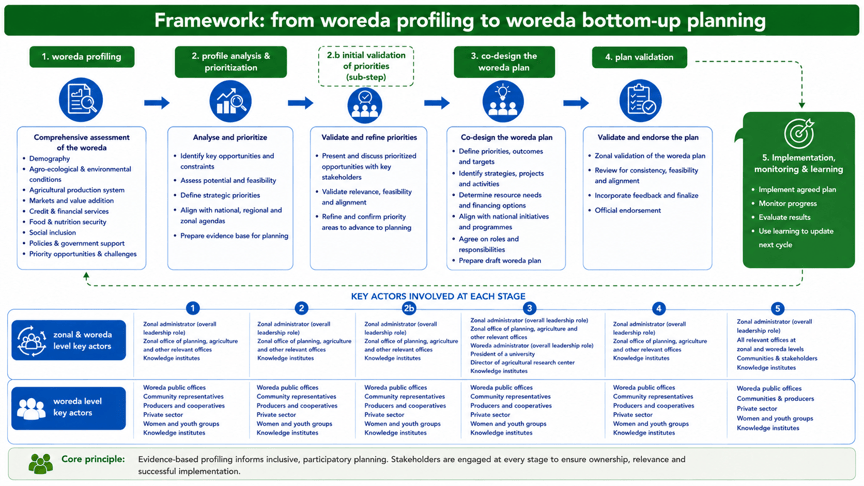
Woreda food system profiles: Detailed profiles provide an evidence-based understanding of local demographics, production systems, markets, nutrition, and social inclusion. These profiles are crucial for identifying leverage points and designing targeted interventions.
Innovation recommendation mapping (IRM): This component identifies context-specific innovations and scaling niches through spatial and stakeholder-informed analysis. IRM integrates biophysical, social, economic, and infrastructural data to locate suitable niches for scaling innovations.
Alignment with national and regional strategies: Local plans are designed to reinforce broader strategies and flagship programs, ensuring that interventions at the woreda level are in harmony with national development goals.
Woreda bottom-up planning: Active participation of local stakeholders is integral to crafting, implementing, and monitoring plans. This participatory approach ensures that interventions are relevant and sustainable.
Key steps for evidence-based planning
The Woreda LMAT approach involves several key steps:
- Mandating relevant actors for collaborative governance and implementation.
- Conducting woreda food system profiling using Rapid Food System Appraisal (RFSA) and baseline surveys.
- Utilizing Innovation Recommendation Mapping to identify suitable locations and inputs for innovation bundles.
- Aligning local plans with national and regional strategies.
Engaging in woreda bottom-up planning to coordinate implementation, monitoring, and scaling of selected innovations.
The role of knowledge institutes
Knowledge institutes play a central role in supporting profiling, plan design, technology testing, capacity building, and Monitoring, Evaluation, and Learning (MEL) activities. These institutes collaborate with zonal and woreda administrations to ensure that plans are evidence-based and contextually relevant.
Implementation strategy
The implementation strategy assigns explicit roles and responsibilities across federal, regional, zonal, woreda, and kebele levels. Resource mobilization is tied to annual budgeting, with key activities including adapting the guideline to regional contexts, building capacity, coordinating multi-sectoral implementation, and establishing MEL systems to track progress and adapt strategies.
In conclusion, the Woreda LMAT guideline represents a transformative approach to integrating bottom-up and top-down planning in Ethiopia. By aligning local plans with national and regional priorities, addressing multidimensional community needs, and promoting sustainable development, the framework aims to maximize each woreda’s potential within Ethiopia’s broader transformational agenda. Through phased scaling from pilot zones to national mainstreaming, the guideline sets the stage for a more resilient and inclusive agricultural future.

